




Dupont
Industry

Products Used
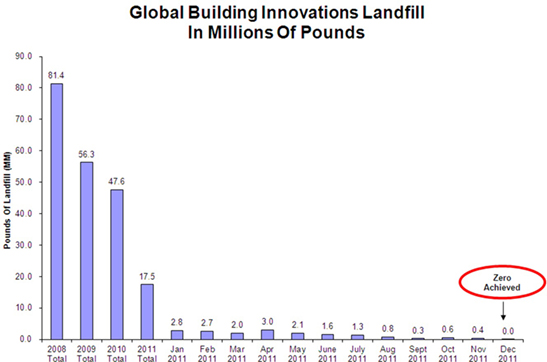
DuPont Building Innovations helps builders create more efficient and sustainable structures, with advanced products including DuPont™ Tyvek® Weatherization Systems, DuPont™ Corian® solid surfaces, DuPont™ Zodiaq® quartz surfaces, and more. This year they added a new innovation to that list: they reduced the amount of landfill they generate to zero. This was no small task—in 2008, Building Innovations produced 81 million pounds of landfill at 15 locations, a volume equivalent to nearly 16,000 cars or 1,000 loaded tractor-trailers. Dave Walter, Americas Business Manager for DuPont Building Innovations, led the global Six Sigma project team that achieved this zero landfill rate. A trained Six Sigma black belt, Walter used Minitab Statistical Software to analyze and make sense of the tremendous amount of data gathered throughout the project.
The Challenge
DuPont first established environmental goals more than 20 years ago, and today the company ties those goals directly to business growth and to the development of safer, more sustainable products. The Building Innovations unit chose to tackle an extremely ambitious goal: Within three years, the division would generate zero landfill waste at all of its global manufacturing sites, reusing or recycling all byproducts.
The Drive to Zero landfill project was particularly complex because it included third-party partner sites, where products are often made not just for DuPont but also for other companies. This meant the project team had to manage the challenge of eliminating all related, as well as unrelated, product manufacturing landfill waste. The project covered 15 manufacturing and partner locations dispersed throughout the world, and included sites in Buffalo, NY; Thetford, Quebec; Ulsan, South Korea; Utsonomiya, Japan; Guangzhou, China; Luxembourg; and eight third-party locations in the U.S.
Manufacturing byproducts, unusable raw materials, product scrap, construction debris and even cafeteria waste all fell within the project’s scope. "In all, we needed to look at more than 30 different waste streams," Walter says. "For each stream we had to figure out, why is it waste? Where’s it coming from? What are the components? And finally, what can we do about it and how can we change the process?"
Given the sheer scope of the project, the team needed to collect a lot of data to help DuPont and its partners rethink and reengineer Building Innovations’ processes. "What we did first was map out what we were doing," explains Walter. "We measured our inputs, the outputs and the waste stream. We used the Six Sigma method called DMAIC, which stands for Define, Measure, Analyze, Improve, and Control."
How Minitab Helped
Six Sigma methodology was used throughout the three years of the project, so features built into Minitab—the statistical software that’s been used to analyze data in virtually every major Six Sigma deployment worldwide—were ideally suited to helping the team accomplish their goals. The data-driven approach was critical because it enabled the team to understand not just how much waste was being produced, but also where and why waste streams were generated. "We used Minitab to help us map out steps along the waste streams," Walter explains. "As we collected data at different sites, we used Minitab to do linear regression and other analyses, and created boxplots, histograms, and other graphs so we could clearly see what our data were telling us."
The team examined each location thoroughly to understand exactly how much of each type of waste was generated; where it came from; why it was produced, and how much material in each waste stream could be eliminated, reused, or recycled. "We did a lot of factorial DOE analysis in Minitab to look at quality versus production time and waste values," Walter says. "We analyzed our data in Minitab to determine how to change a process to reduce waste, while making sure we didn’t affect the quality of our products."
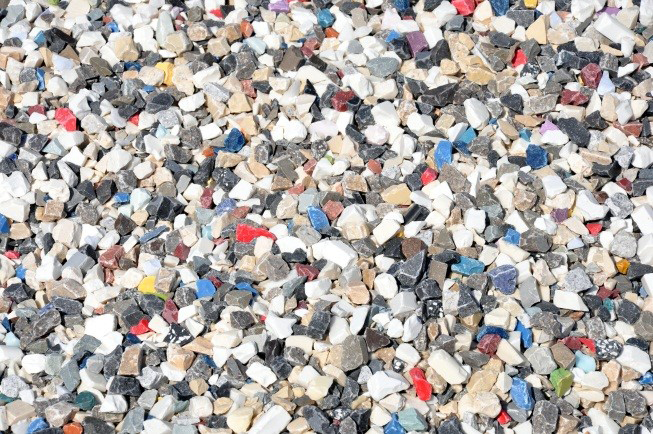
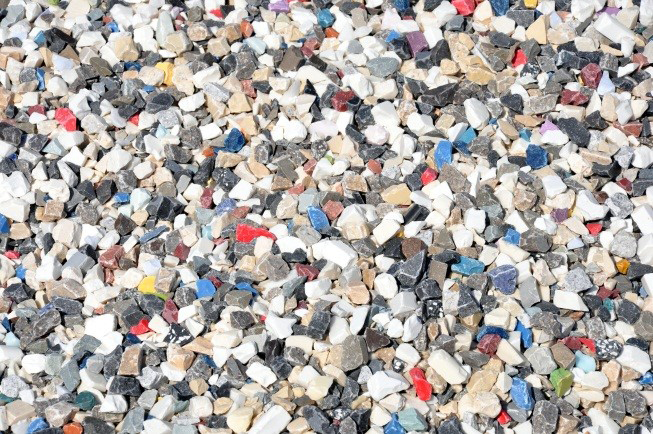
Along the way, the team found surprising ways to reduce the amount of "waste" generated. "Finding things that we were able to sell was a very pleasant surprise," Walter says. "For example, now we can sell things such as landscaping stones made from Corian® scrap material that previously would have been thrown away."
Results
The team achieved their goal of zero landfill in the last month of their three-year schedule. "The last 2 million pounds from around the world were the most difficult," Walter says. "But today, a tremendous amount of material that used to end up as landfill gets reused or recycled."
The list of useful byproducts Walter’s team culled from Building Innovations’ processes is impressive. For example, Corian® scraps turned out to have great utility. "We trim each sheet we make, so there’s natural waste that was coming from this process," Walter says. "There is also transition material that is created as we change from one color of material to the next. Now, instead of putting them into a landfill, we can grind up many of our scrap sheets to reuse in our first-grade product. We also can crush the remaining scraps for use as drainage rock."
And the list continues. Sanding waste from the Corian® and Zodiaq® manufacturing processes is used as a filler replacement in concrete. Tyvek® wrap and flashing trim is recycled into first-grade material. Shipping pallets are repaired, reused, or ground into animal bedding. Carrier belt film is melted and used to make adhesives. Even cafeteria waste from Building Innovations facilities is recycled into worm bedding or converted into energy.
But this project yielded financial as well as environmental benefits. Amazingly, the team achieved its mission with no capital expenditures. And in just one year, Building Innovations earned $2.2 million from the sale of byproducts globally, in addition to realizing $400,000 in cost savings.
DuPont Building Innovations received the first-ever Supplier Sustainability Award from the U.S. Restaurant Development group at McDonald’s® for its zero-landfill achievement. And the Building Innovations marketing team is finding ways to boost sales by leveraging the the business’s commitment to sustainability among environmentally-conscious consumers.
Now that the project team has accomplished its zero-landfill goal, it continues to use Minitab for data analysis. "Minitab is important in our auditing process," Walter says. "Every week we’re checking our numbers, making sure the right materials are going into the right containers, and we use Minitab control charts, histograms, and other tools to make sense of the data we collect. Minitab is very powerful and easy to use, and when you have questions about the ins and outs of a particular analysis or method, the clarity Minitab provides us with is really very helpful."
But, Walter points out, one indicator of the team’s success can be easily detected even without Minitab Statistical Software: "We no longer see any trucks coming into our plants to pick up landfill waste," he says.