




JW Aluminum
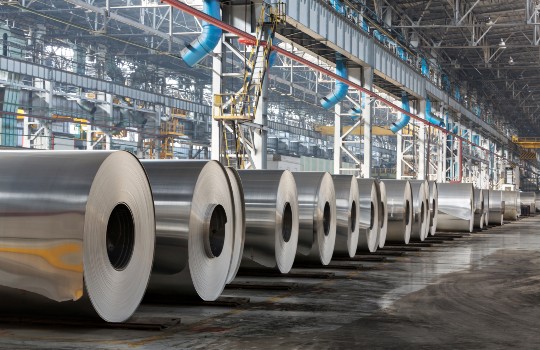

For JW Aluminum, continuous improvement is ultimately about serving customers better. Its customers are manufacturers whose production plans depend on receiving the right material at the right time. Reliable, predictable delivery gives those customers greater confidence in their own production schedules and helps them navigate changing demand in a dynamic marketplace.
JW Aluminum manufactures flat-rolled aluminum products for a range of demanding applications.
At its Goose Creek, South Carolina facility, the company operates an interconnected production system where rolling, annealing, scheduling, quality, and material availability influence lead times. But reducing lead times while maintaining delivery reliability takes more than asking individual processes to run faster.
JW Aluminum wanted a scientific, data-driven way to understand how material moves through its production system, identify the constraints that extend lead times or create variability, and determine which improvements would have the greatest impact on customers.
Simul8 allowed the team to test potential decisions virtually before putting them into practice.
The Challenge
The challenge was not simply to calculate theoretical throughput.
JW Aluminum needed to understand how:
- Product routing
- Equipment capabilities
- Scheduling
- Upstream materials
- Quality outcomes
affected the plant’s ability to produce consistently—and how those factors ultimately influenced customer delivery.
As part of its ongoing planning process, JW Aluminum needed simulation modeling to identify and optimize production opportunities.
The company also wanted a shared way for leadership, operations, and scheduling to evaluate ideas, challenge assumptions, and agree on which enhancements should take priority. A common view of the production system would help teams focus on the changes most likely to make a difference.
How Simul8 Helped
JW Aluminum began by building a current-state model in Simul8. The goal was to recreate how the plant was performing, including the hours required on key resources and the amount of finished material leaving the facility.
The team progressively added real-world constraints and compared the model with actual operations. When differences appeared, JW Aluminum worked with Simul8 to identify what was missing and represent those conditions more accurately. The model came to closely replicate plant performance, giving the team a reliable environment for testing potential changes.
JW Aluminum then presented the current-state model to the management team, and plant leaders were encouraged to challenge the model and identify anything that didn’t look right. The team refined it based on their feedback before moving to future-state scenarios, building confidence in both the model and the decisions it could support.
The validated model was used to test routing, scheduling, upstream material, and quality refinements.
JW Aluminum modeled three routing changes and one quality-related change, giving teams a common fact base to compare options and agree on impactful next steps.
Simul8 also helped quantify ideas that had previously been supported mainly by operational experience. In one example, the team evaluated whether certain products should continue moving between two mills for flexibility or be routed through one higher-powered mill to reduce the number of rolling passes. The model showed where consolidating routes could deliver a meaningful productivity benefit.
The team also modeled the effect of reducing the thickness of material arriving from an upstream process. JW Aluminum had identified and discussed the possible change before, but quantifying its impact helped the broader organization understand its importance and raise its priority.
One of the clearest insights involved the annealing ovens. Each oven could hold six coils, so the original model assumed full six-coil loads. When the results did not match actual production, the team reviewed the operating data and found that ovens often received only four or five coils, with an average closer to five. Upstream rolling could not always provide six compatible coils quickly enough to keep every oven full.
Once that constraint was added, the simulation came close to the plant’s actual production rate.
This finding helped JW Aluminum focus on improving upstream flow and equipment availability so the ovens could be loaded more consistently and efficiently.
More consistent loading could help optimize oven utilization, support dependable scheduling, and further support reliable delivery to customers.
Results
Simul8 gave JW Aluminum a clearer view of its production capabilities and the improvements most likely to support future demand. The model highlighted measurable opportunities involving routing, upstream material, oven utilization, equipment reliability, and quality. It also showed how constraints could shift as production increased, giving teams a stronger basis for planning and prioritization.
The model turned operational hypotheses into shared evidence. Leadership, scheduling, and operations could review the same results, challenge the same assumptions, and align around the changes most likely to deliver value.
“Simul8 allows us to evaluate improvement opportunities with greater confidence and align our organization around fact-based decisions. It’s a valuable tool in our pursuit of operational excellence, helping us prioritize the improvements that strengthen our ability to deliver reliably and consistently for our customers.”
Ben Walden
Vice President of Continuous Improvement, JW Aluminum
This shared understanding helped move continuous improvement opportunities from discussion toward coordinated action. The project showed how simulation could help teams evaluate options, understand one another’s priorities, and make decisions together.
JW Aluminum continues to develop and use the model as new questions emerge. By quantifying what the plant produces today and where enhancements can support demand, the company can plan with greater confidence and support on-time delivery.